Capturing ultra-high-resolution plates for VFX and virtual production traditionally requires multi- camera arrays consisting of 6 to 9 cameras. While effective for resolution, arrays introduce systemic engineering bottlenecks that a single specialised sensor like the ACHTEL 9×7 resolves.
1. Eliminating Optical and Sensor Artefacts
Multi-camera arrays inherently require stitching in post-production, which introduces severe optical complications:
-
- Parallax Errors: Offset nodal points create perspective mismatches between lenses that cannot be perfectly flattened.
- Split Lens Flares: Physical light leaks and flares break across stitched seams, requiring extensive digital painting.
- Rolling Shutter Desynchronization: Minor timing offsets between multiple sensors create stitching tears during fast panning or high-speed motion.
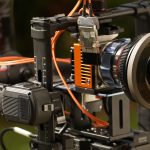
The ACHTEL 9×7 captures the entire frame through a single optical path, completely bypassing the need for stitching and eliminating these artefacts at the source. It also features global shutter sensor eliminating any temporal disparities entirely.
2. Resolution and Optical Performance
The 9×7 sensor does not just match multi-camera arrays; it regularly exceeds the effective image quality of 6-to-8 camera rigs.
-
- Uniformity: It ensures 100% consistency in color science, exposure, and contrast across the entire plate without digital matching.
- Edge-to-Edge Sharpness: Combined with specialized large-format optics, it delivers uncompromised MTF (Modulation Transfer Function) data across the frame, outperforming stitched arrays that degrade at lens edges. The 9×7 also outperforms 15-70mm film in all measurable aspects of image quality including sharpness (MTF).
3. Rigging Logistics and Weight Considerations
Multi-camera arrays are heavy, bulky, and mechanically complex. They limit camera placement and movement due to physical constraints:
-
- Payload Constraints: Array rigs require heavy-duty cranes or specialized vehicles, making them incompatible with standard, lightweight gimbals.
- Spatial Limitations: Large brackets cannot physically fit into tight spaces (e.g., car interiors, narrow corridors).
The compact, single-body form factor of the ACHTEL 9×7 allows for high-resolution plate capture on lightweight stabilization systems and inside confined environments where arrays cannot operate.
4. Production Economics
Operating a single camera package yields direct logistical cost reductions over multi-camera configurations: It eliminates the need for 6 to 8 matched lenses, multiple wireless video transmitters, and synchronized power distribution systems. Also, fewer data streams and zero alignment calibration reduce setup times, saving expensive crew hours during production windows. Typically dailies can be delivered within an hour and editorial and backups within a couple of hours after capture – something that is not possible when stitching multiple camera sources is required.