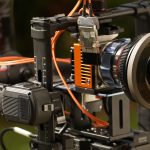
This camera test was performed jointly by members of GSCA Innovations Committee and ACS Technical Committee in May 2025. The goal of the tests was to evaluate and measure image quality for immersive cinema 12K and 8K LED Dome theatres. Three cameras were selected: ACHTEL 9×7, RED Raptor 8K and SONY Venice 8k. The results were presented by GSCA Innovations Committee at the conference in COSM LED Dome at Fort Worth Science Center, TX, USA. Here we are sharing some of the content that has been captured.
Original RAW files are available for evaluation by request.
ACHTEL 9×7
Achtel 9×7
Sensor Size: 29.9 x 22.4mm CMOS
Max Resolution 9344 x 7000 (1.33)
Max Frame Rate 70fps
Internal ND: No
Shutter: Global
Media: Proprietary internal storage located in a separate recording module
Dimensions: (WxHxD) Camera head: 80x 80mmx 70mm,
recording unit: 136 x 166 x 66mm
Weight: Camera Head: 1.54 lbs./.7 Kg Recorder Unit: 5.51 lbs./2.5 Kg
Lens Mount: Interchangeable LPL, PL, E-Mount, PV, Nikon, and Leica-M.
Battery Mount: V Mount
RED Raptor 8K
RED V-Raptor XL 8K VV
Sensor Size: 40.96 x 21.6 mm CMOS
Max Resolution 8192 x 4320 (1:89)
Max Frame Rate 120 fps
Internal ND: Optical, 7 Stops, Clear
Shutter: Rolling
Media: CFexpress Type B (CFast 2.0)
Dimensions (WxHxD): 4.55 x 4.25 x 5.89″ / 115.5 x 108 x 149.63 mm
Weight: 7.99 lb / 3.62 kg (Body Only)
Lens Mount: Interchangeable, comes with PL mount
Battery Mount: V Mount or Gold Mount
SONY Venice 2
Sony Venice 2
Sensor Size: 36.2 x 24.1 mm CMOS
Max Resolution 8640 x 5760
Max Frame Rate 29.97 fps
Internal ND: Optical, 8 Stops, Clear
Shutter: Rolling
Media: Dual Slot: AXS-A, Single Slot: SD/SDHC
Dimensions (WxHxD): 9.84 x 6.22 x 5.98″ / 249.94 x 157.99 x 151.89 mm
Weight: 9.5 lb /4.3 kg (Body Only)
Lens Mount: Comes with PL with E-Mount recessed inside
Battery Mount: V Mount or Gold Mount
Recording Format
Linear Uncompressed RAW 16-bit
Recording Format
Compressed REDCODE HQ 12-bit Log
Recording Format
X-OCN XT 16-bit Compressed RAW
Lens used: Sigma Cine 28mm T1.5 at T2.0
RED Raptor 8K is ISO invariant (ISO settings do not affect sensor sensitivity or RAW values) and it is metadata only. This shot was filmed at ISO 3200 at 24p.
Sony Venice 2 features two native ISO settings. This shot was filmed at ISO 3200 at 24p.
ACHTEL 9×7 has eleven (11) native ISO settings. This shot was filmed at ISO 3200. The highest native ISO setting on 9×7 is ISO 5400.
Lens used: Custom Sigma 15mm T1.5 PL Manual Focus at T4.5 – one of the sharpest (if not the sharpest) lenses ever made.
Resolution Charts can objectively reveal the true resolving power of cameras and lenses in
terms of line pairs per millimeter. Because the chart is flat, a longer lens is required to capture it
without distortion, so we used the same Sigma 65mm T1.5 PL at T4.0 on all cameras.
This Yotta chart (above left) is the professional choice world wide for 8K camera rental
companies wanting to ensure their cameras and lenses meet the highest standards for image
quality.
When photographed from fifty times the focal length of the taking lens, the Yotta chart can
indicate the actual resolutions of any lens/camera combination, up to 250 line pairs per
millimeter (LP/mm).
However, since this was a camera comparison test, all cameras were aligned to a common top
and bottom when framing the Yotta chart. The left and right edges of the sensor frame varied
but were all cut off for a square extraction for the LED Fulldome.
In this case, the Yotta chart showed relative camera resolving power, not the absolute value in
terms of LP/mm.
The chart’s center test patches are sets of concentric circles designed to reveal
camera aliasing, moire patterns, and lens astigmatism on every axis. They are numbered from
four to fifty-five. The lower the number, the higher the relative resolving power of the cameralens
combination.

These are the results we found (a lower number is better):
The ACHTEL 9×7 camera resolved test pattern 6, significantly better than any other camera.
The RED Raptor 8K resolved test pattern 11
The SONY Venice 2 resolved test pattern 9
A Siemens Star Chart was shot for each camera and entered into Imatest Master software
that creates a Modulation Transfer Function (MTF) chart indicating each camera’s resolving power, in
lines per picture height. These tests present absolute resolution numbers and were consistent
with the Yotta chart results. MTF20 is typically considered as perceived resolution limit because we, humans, need at least 20% contrast in order to resolve small detail with our eyes. MTF50, on the other hand, is often regarded as perceived sharpness because human eyes can clearly see small details with at least 50% contrast.
The MTF results above indicate that:
We need at least four (4) Sony Venice 2 cameras stitched seamlessly to match the sharpness of single ACHTEL 9×7 camera.
We need at least six (6) RED Raptor 8K cameras stitched seamlessly to match the sharpness of single ACHTEL 9×7 camera.
The Achtel 9×7 had unmatched fulldome image quality when compared directly with the other cameras. It can also future proof content for higher resolutions than 8K x 8K. Next up for image quality would be the Sony Venice 2 tied with the Ursa 12K LF, followed by the Canon R5 C roughly tied with the Nikon Z8.
While the RED Raptor VV had the lowest apparent resolution, it alone offers 120fps capture, important to wildlife photography using longer lenses, which are far more forgiving with resolution. [Sean Phillips, ASC]

Acknowledgements:
Many thanks to The Front Camera Rental for providing cameras, lenses, Lens Projection Room and Testing Bay facility.
ACS Australian Cinematographers Society: Aleksei Vanamois, Elena de Bruijne, Susan Lumsdon, Anthony Manion 1st Assistant camera
Achtel 9×7, Entaniya Hal 220 LF Lens, Sigma 15mm PL Fisheye Lenses
Duclos Lenses: Entaniya Hal 220 LF
Bryan Smith/Reel Water Productions Ltd.: Entaniya Hal 220 LF
DIT Services: by Nathan Cohen Productions
Digital Mastering: Moonraker VFX – Simon Clarke, Mark Hartshorn
Produced By:
Sean MacLeod Phillips ASC
Phil Streather
Michael Daut
Nate Cohen